This is a very simple experiment to demonstrate the importance of compiled languages over dynamic or interpreted languages when it comes to system programming or high degree of efficiency.
A simple loop operation to sum up the numbers from 1 to 1,000,000,000 (one billion).
Clone the repo, then open src/ directory.
C++ run:
$ g++ cplusplus.cpp -o cpp -O3
$ ./cpp
Java run:
$ javac java.java
$ java Java
C# run:
Note: use mono on macOS/linux only.
$ csc csharp.cs
$ mono csharp.exe
Python run:
$ python python.pyRuby run:
$ ruby ruby.rbJavascript (node) run:
$ node javascript.jsGo run:
$ go build go.go
$ ./goTo obtain the time spent on execution, measure the last line of each run with time multiple times and get the average.
For example:
$ time java Java
...
real	0m0.395s
user	0m0.361s
sys	0m0.028s

$ /usr/bin/time -l java Java
...
22679552  maximum resident set size
Results breakdown (macOS mid 2015, 2.5 GHz Quad-Core Intel Core i7, 16 GB RAM):
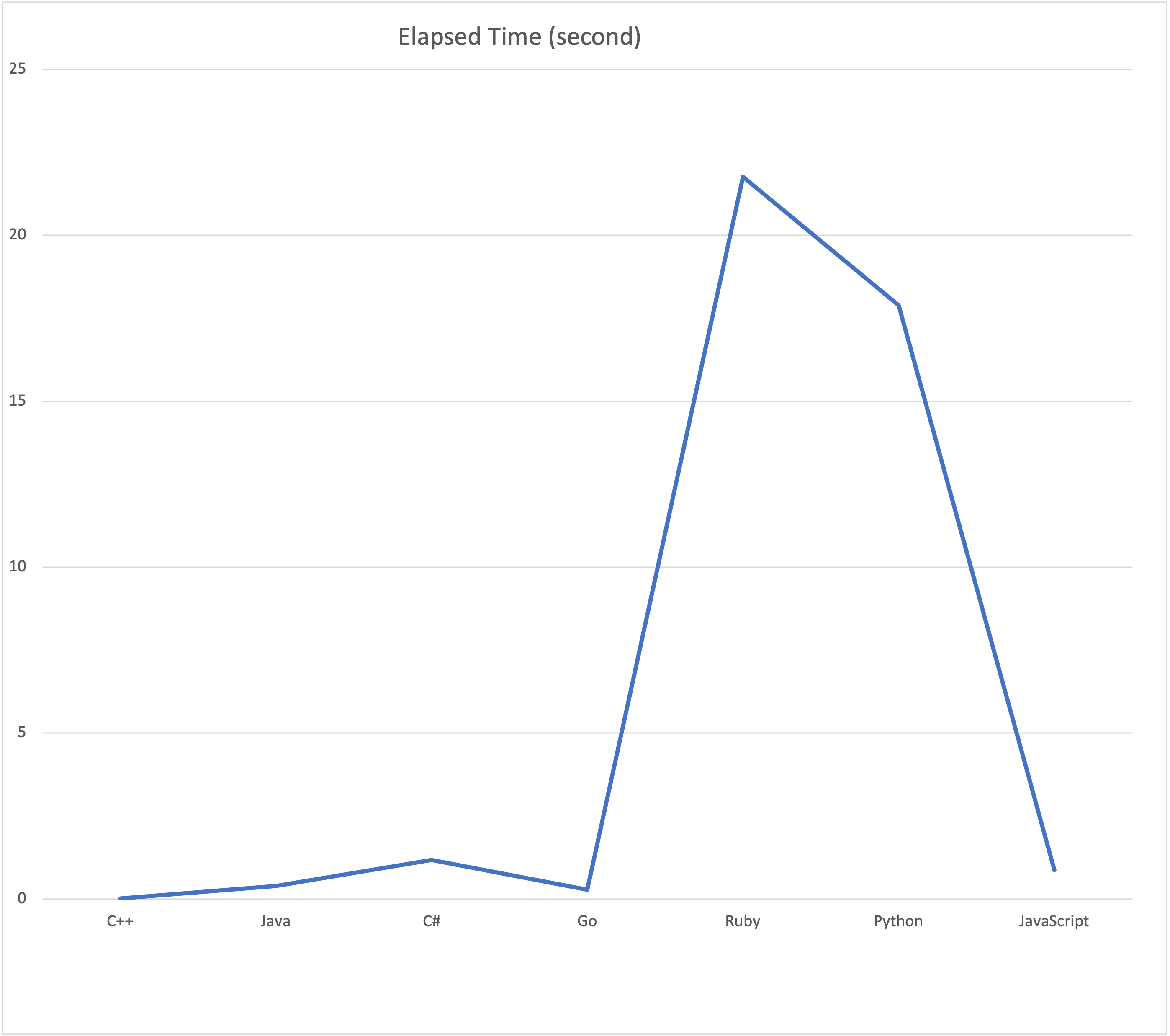
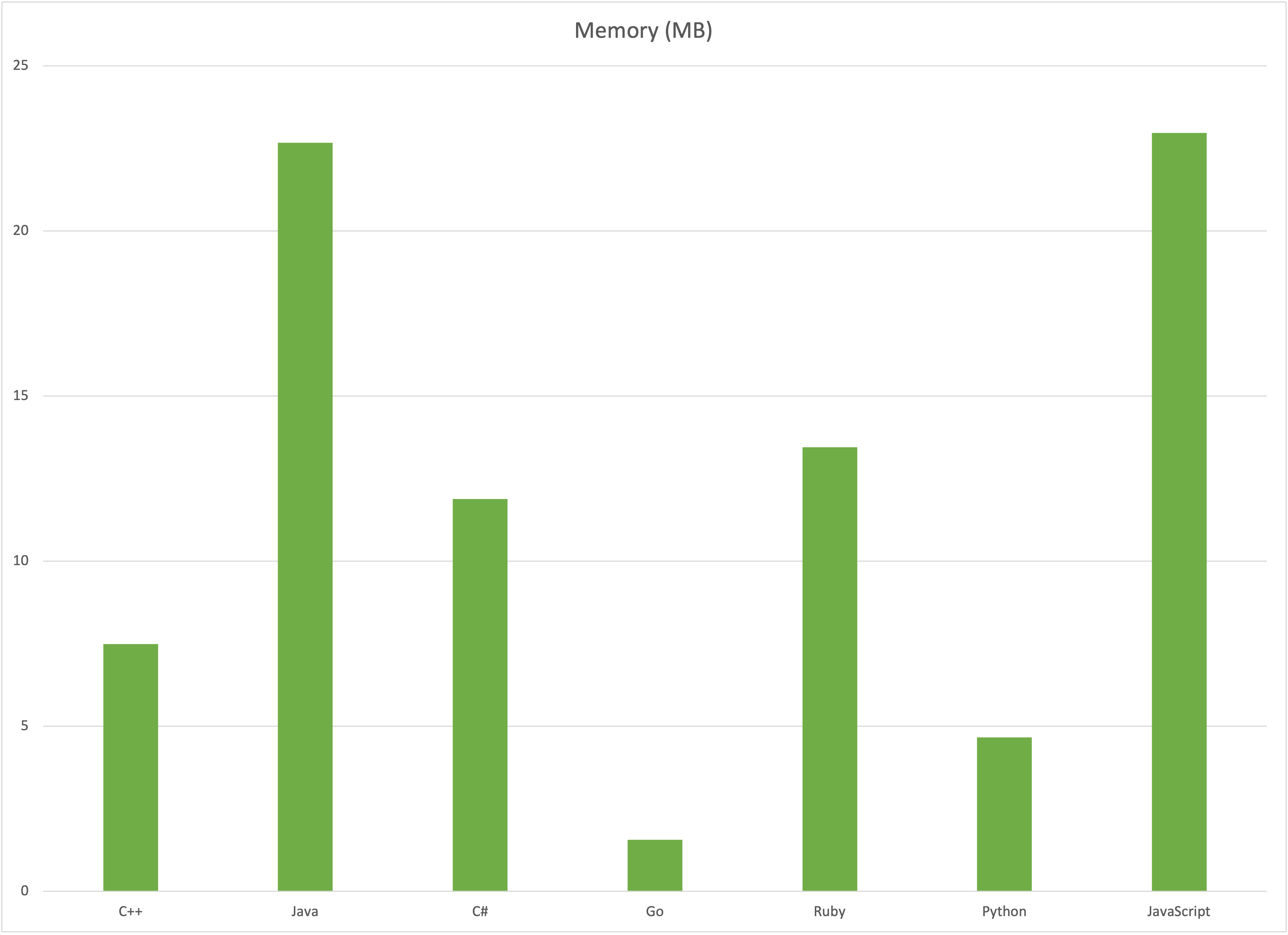
| Language | Elapsed Time (second) | Memory (MB) |
|---|---|---|
| C++ | 0.015 | 7.49 |
| Java | 0.39 | 23 |
| C# | 1.172 | 11.88 |
| Ruby | 21.77 | 13.45 |
| Python | 17.89 | 4.66 |
| JS (node) | 0.873 | 22.97 |
| Go | 0.284 | 1.56 |
Clearly, the way of optimization of this pure calculation logic in compiled versions as we see in static compiled languages outperformed the interperted languages (except nodeJs) drastically in terms of speed. Additionally, Java and C# results show the outstanding optimization made to the compiler and runtime JVM/CLR to perform nearly identical to the low level languages, for such essential looping computing.
The two figures below show the comparison between C++, C#, Java, Ruby, and Python languages in terms of both speed (time) and memory (space).
All PRs are welcome for other languages or improvements on Github.
MIT.
- Abdullah Barrak (@abarrak).
- Eliot Akira (@eliot-akira).