This documentation is intended to be read with a search engine and a Large Language Model (LLM) open next to you.
No prior knowledge is needed, only curiosity and patience.
...this is a lie.
I'm secretly expecting you to have touched at least one of: C / C++ / Rust / Go / JavaScript / Python.
But if you’re curious enough, and you’re allowed to Google / ping an LLM, you’ll probably find your way through anyway.
What this documentation is not :
- a C tutorial
- an x86/ARM reference
- an OS textbook
- a functional programming textbook
- a step-by-step "learn to code" guide
I will happily skip "obvious" syntax, wave my hands over some details, and tell you:
Ask the LLM: explain this thing in 5 lines, you've seen the context.
You are expected to:
- look things up,
- try tiny experiments,
- run your own code,
- and occasionally tell the LLM "no, that's wrong, try again".
Roughly I only cover:
- the models
- the connections
- the taste (at least my taste)
You should imagine this as the spine, and the rest of the internet as flesh you can grow on demand.
If you're still here after this introduction, congratulations: you are probably the target audience.
Turn the page. We start with bits, and some lies about integers.
Computers don't have integers.
They have bits. We’re the ones who insist that a certain pattern of bits "is a number", and not, say, a color, a character, or the high score of some dead arcade machine.
We start with the simplest lie:
bool — one bit. 1 or 0. True or false. Non-fuzzy, allegedly.
Of course, the compiler will happily store it in a whole byte anyway, because hardware likes alignment more than it likes philosophical minimalism.
trivia: Church number
byte — 8 bits.
Why 8? Historical reasons. We could have standardized on 9. Or 12. We didn't. Now all your text, file formats, and protocols silently assume "8" like it was handed down from the mountain.
we all live in the contingent shadow of history
Then we get to the mess: int, short, long.
Once upon a time, these meant something like "the machine's natural word size".
Note
By "word", it has a vaguely similar flavour to the Western-centric idea of a "word": imagine a single letter is a bit, and a word is a meaningful unit made from multiple letters (bits). It's not a correct analogy (you'd need information theory to really do it justice), but that’s roughly how I imagine the term "word" stuck.
That made sense when machines were small and weird. Today we have <cstdint>
because nobody wants to play "guess the number of bits" anymore. We summon
uint32_t and it does what it says on the tin. Mostly.
Signedness is its own little horror story.
int32_t vs uint32_t vs "some encoding that pretends to be both". ZigZag
encoding, in protobuf, is basically a hack that says: "what if we pretended
signed integers were just unsigned integers, but we wrapped them in a clever
zig-zag pattern so small negative numbers compress well?
The machine doesn't care. The ALU just sees 32 bits. We're the ones saying "this is an age" or "this is −1" or "this is a file descriptor". Types aren't in the silicon; they live in the agreement (in human sense).
and for multi-byte integers, endianness. (spoiler: most of the time you want little-endian, except for network stuff and IBM mainframes)
The problem of endianness comes from human languages/writing system.
Most of the sane world writes left-to-right (like English, modern Chinese, etc), like how we write numbers: the most significant digit on the left, the least significant digit on the right, so called MSD (most significant digit) first,
i.e.
1234 = 1*10^3 + 2*10^2 + 3*10^1 + 4*10^0
In right-to-left scripts (Arabic, Hebrew), text flows right -> left, but the digits themselves are still written in the same order we use: the "1" in 1234 is still the thousands place, the "4" is still ones. So you get this weird hybrid: text goes one way, numbers another.
In a hypothetical LSD (least significant digit) first writing system, the same numbers would be written like this:
4321 = 4*10^0 + 3*10^1 + 2*10^2 + 1*10^3
while the same representation 1234 would mean:
1234 = 1*10^0 + 2*10^1 + 3*10^2 + 4*10^3
Note
Don't forget top-to-bottom ("column-first") writing systems (traditional Chinese/Japanese/Korean). If you treat the page as a 2D array, you’re essentially:
- going down for each character in a column
- then moving left to the next column
We don't normally write numbers bottom-to-top (thankfully), but the idea of "which direction do we advance the position in?" is the thing that matters.
Back to computers.
Due to the flat memory model, and a given address grows direction, how would you interpret a multi-byte integer stored in consecutive memory addresses?
consider a uint32_t stored at address 'a':

0A0B0C0D (MSB first, big-endian, like how we write/read numbers)
    = 0x0A * 2^(8*3) + 0x0B * 2^(8*2) + 0x0C * 2^(8*1) + 0x0D * 2^(8*0)

low addresses  -->  high addresses
|a |a+1|a+2|a+3|
|0A|0B |0C |0D |  # big-endian
|0D|0C |0B |0A |  # little-endian
[!IMPORTANT] MSB/LSB "Most Significant" and "Least Significant" bit.
"Significance" here means "how much weight this position carries as a number": the MSB contributes the largest power of 2, the LSB the smallest.
Fortunately, nobody uses a "middle-endian" writing system where the most significant digit lives in the middle... as far as I know. Consider it an exercise to design such a monstrosity.
We also have the problem of bit endianness (I'd call it significance problem).
with the writing direction analogy:
low addresses --> high addresses
------------------------------
|hello|world|
|world|hello| # endianness problem
|oehll|lrwod| # significance problem
Here, "endianness problem" means you swapped whole words: hello world → world hello. "Significance problem" means you scrambled the characters inside each
word, as if the bits in a byte were being read in the opposite order.
note that, if you changes the low/high address direction, the endianness would be flipped too
Usually the significance won't be a problem (any sane system would do MSB first inside a byte) However, the problem of significance mostly relate to bitfields. i.e.
struct bit_field_plex {
    uint8_t a:3;
    uint8_t b:5;
};
which comes first, a or b? it depends on the compiler implementation.
(but usually it's LSB as first field, and for each number of field, MSB first inside the field)
Warning
by usually I mean most of the little endian common compilers implementations, your mileage may vary
You could verify what your compiler does with this code:
#include <cstdint>
#include <utility> // for std::unreachable in C++23

constexpr bool is_lsb_first_in_struct() {
    const struct test {
        uint8_t all_ones: 4;
        uint8_t all_zeros: 4;
    } t = { .all_ones = 0b1111, .all_zeros = 0b0000 };
    static_assert(sizeof(t) == 1, "unexpected size");
    if (const auto p = reinterpret_cast<uint8_t*>(&t); *p == 0b11110000) {
        return false; // msb first
    } else if (*p == 0b00001111) {
        return true; // lsb first
    } else {
        // shouldn't happen in sane system
        std::unreachable();
    }
}How do we represent decimals?
Naive (and underrated) approach: fixed point — a forgotten art.
Idea: scale by 10 / 100 / 1000 etc., store as integer.
Problem: we have binary machines, not decimal.
So we usually do binary fixed-point: pick a Q-format like Q4.4:
- 4 bits integer, 4 bits fraction → range
0 .. 15.9375 - The LSB of fraction part means
1 / 2^fraction_bits→ here,1/16 = 0.0625precision.
(won't discuss arithmetic here, those are implementation details)
floating point: IEEE 754 standard (single/double precision)
fp32 (float), fp64 (double); fp16, fp8, fp4 (latest NVIDIA GPUs support them)
trivia: neural networks and quantization
needs FPU, which is a separate register set
7 bits, 128 characters, 1 byte aligned non-printable control characters (0-31)
have you ever seen ^C in terminal? that's a 0x03
(the non-printable is actually printable)
a beautiful word borrowed from Go language, which doesn't exist in C, but worth mentioning
National encoding:
- GB2312
- Big5
- Shift-JIS
- EUC-JP
International encoding (Unicode):
- UTF-8
- UTF-16
- UTF-32
Indeed, we have an problem of efficiency here and some Chinese keeps arguing about that. However, we have compression, so let's stop arguing about the encoding and just use UTF-8
trivia: emoji, IPA (international phonetic alphabet) and zero-width joiner
There's no string (in C)
This section should have been placed after Array, but I just can't resist telling this sad truth earlier.
it should be the end of primitive types (or fundamental types), except the misplaced Strings.
Our first generic type -- although historically it was treated as something more "primitive" than generics. Languages had arrays long before they had parametric polymorphism.
Now that we do have generics, we have to retro-fit arrays into that world. I like to call this hole punching: C's array is basically a hole in its type system.
Let’s use C++ syntax instead of C, because it makes the intent explicit:
std::array<T, N>Where:
- T = element type (must have a known size)
- N = number of elements (must be a compile-time integer)
This immediately raises the important question:
Why must the size of T be known?
Hold that thought.
Memory is flat.
If that’s not obvious, go look at the memory map of a microcontroller like the STM32F411.
In its reference manual, see:
- Chapter 5, Figure 14: Memory map
- Table 10: STM32F411xC/xE register boundary addresses
It's quite hard to explain without introducing Von Neumann architecture, Harvard architecture, and what a instruction memory (what we call ROM/Flash) and data memory (what we call RAM) are.
trivia: there's also IO to handle; CPU is just a dumb calculator, things unrelated to calculation/control flow are the realm of peripherals
Nowadays, most of the microcontrollers are (at least pretending to be) Von Neumann architecture, which means:
instructions and data are stored in the same memory space.
What's my question again? "Why a known size is so important?"
memory is flat
go back to array again
An array is a data object holding elements of the same type, identified by a numeric index. Elements are allocated consecutively in memory.
except VLA (variable-length array), which just a fancy alloca
In flat memory, the whole point of an array is that you can find element i by:
address_of(arr[i]) = base_address_of(arr) + i * sizeof(T)
This only works if sizeof(T) is known and fixed at compile time.
If you don’t know the size, you can't compute the offset.
a famous macro:
#define ARRAY_SIZE(arr) (sizeof(arr) / sizeof((arr)[0]))null-terminated byte array; or called sentinel-terminated array
char str[] = "hello";equivalent to
char str[/* 6 (optional, the compiler could infer the size) */] =
    {'h','e','l','l','o','\0'};
equivalent to
char str[6] = {0x68, 0x65, 0x6c, 0x6c, 0x6f, 0x00};Did I said a single quote ' is for a single character?
(I'm not teaching you C syntax here, just a reminder)
My opinion is here: it's a bad design, please go for slice/span/view, if you have a choice (often you don't, sadly)
someone said it's fat. (it is fat)
to proper write it down, you would need have to know struct first.
spoiler alert:
struct slice_t {
    void* ptr;
    size_t len;
};
Please don't ask what void* really is.
In this context, I genuinely have no idea either.
(And I promise that's not a joke.)
Our second generic type (after array)
Ross sat on the Algol 68 committee with C.A.R.Hoare in the mid-1960s, where his previous work on a record-like data structure (called a plex) influenced Hoare's own ideas on abstract data types...
-- Alan Blackwell and Kerry Rodden (2003) Sketchpad: A man-machine graphical communication system reissued edition with preface by Blackwell and Rodden
See Casey Muratori – The Big OOPs: Anatomy of a Thirty-five-year Mistake – BSC 2025 for more of this story
Long story short: we probably should have called it a plex instead of struct. (It sounds cooler, and is historically closer.)
Well, it has other names: record, tuple (field name is replaced with position index), product type (in type theory).
trivia: algebraic data types (why product?)
Anyway, here's a struct
struct a_plex {
    uint32_t a;
    float b;
    int8_t c;
};
You then have to write struct a_plex everywhere (in C), which gets old fast.
so many people do this:
typedef struct a_plex a_plex_t;Also, many people like to do this:
typedef struct {
    uint32_t a;
    float b;
    int8_t c;
} a_plex_t;
I refuse the latter, because technically that's:
- an anonymous struct
- that’s been given a name only via
typedef.
It works, but the struct itself is never get registerd in the struct namespace. I like my structs (or plexes) named.
Why the typedef dance?
cuz C struct lives in a different namespace than other types, unlike C++.
Try to guess the size of a_plex above.
If the answer is 9 bytes, you're tricked by alignment and padding.
to make it 9 bytes really, you always could add __attribute__((packed)),
although the CPU might be not happy (and sometimes traps you)
trivia: bit-field
The size of union is the size of its largest member.
However, it never knows which member is currently active. That's not the job of the union itself.
By itself, union is just basically useless, but here's a trick I'd like to share:
struct color {
    union {
        struct {
            uint8_t r;
            uint8_t g;
            uint8_t b;
            uint8_t a;
        };
        uint32_t rgba;
        uint8_t components[4];
    };
};
Reinterpret the same memory block in different ways.
Enum
Just a named integer constant and Go even doesn't have enum.
atom is way more interesting, but it's not in C.
I said:
By itself, union is just basically useless...
Here comes Tagged union
Remember struct's other name? Product type.
Now we have Sum type.
class is struct with default access specifier private in C++.
and module is a struct with all its members static, or a sigleton class in OO's perspective.
Although C/C++ doesn't have the concept of module (except C++20 module, which nobody uses yet), they only know compilation unit (translation unit).
Zig has made this fact clear: every file is a struct, which you can import and access its members, which is what we often call module in other languages.
While in OCaml, we could have a functor to
generate modules from other modules, C++ has templates to achieve similar goals.
A functor in OCaml is a parametrised module, not to be confused with a functor in mathematics.
For the variables/fields inside a module/struct, they must live somewhere in
memory. If you could figure that out, you might grasp the mi-dire. After all, this just a hidden pointer passed as the first
argument to member functions.
This is the end of C types. (is it?)
If you're the one who is familiar with C, you might have noticed that there's something I (intentionally) missed.
Go back to Turing machines / von Neumann architecture and
forget the high-level control flow: function / if / while / for / switch / etc.
Those are also illusions.
In a sense, today's computers are not much different from punched-tape machines: a head, a tape, a position, and some rules about how to move.
Before reading this section, go to Introduction and
try to think like a CPU.
(And stay aware of your position in the text.)
You shouldn’t read this line.
Branching = changing the PC (program counter) register to a different address.
In prose form:
if some condition, jump to there instead of continuing here.
You've just done a branch: the text told you to go to another label (Introduction) instead of reading straight down.
If you're reading this paragraph before reading Introduction, you've mis-executed the program. Please go back to Introduction and try again.
(Yes, I know this is duplicated if you followed the instructions properly. Welcome to unstructured control flow.)
Registers: small boxes inside the CPU. To do a calculation, you first have to put values into boxes.
Instruction Set Architecture (ISA): the set of instructions the CPU understands. Or, if you prefer: the minimal operations the hardware can perform.
PC register (Program Counter): the address of the next instruction to execute.
If no branch happens:
- fetch instruction at
PC - execute it
- increment
PC - repeat
If a branch happens:
- set
PCto some other address - execution continues there instead
Does anybody mention branching?
- If you don’t know what that means yet, go to Branch.
- If you do, you are now allowed to keep reading past this point.
When we say the word register, we might mean a quite different thing
- Flip-flop/latch, who remember bits (do they really "remember"/"memorize"? or are we anthropomorphizing circuits?)
- the small boxes inside the CPU, where we do calculations (ALU's)
- thouse indicate the state of CPU (like PC, SP, etc) they have nothing to do with calculation
- some special memory addresses, when we read/write to them, it's not really memory access (although we still treat them as memory, as von Neumann's magic suggests), but actually interact with peripherals (or, parts that are not part of CPU core, not involving control flow or calculation)
- some field in protocol like Modbus, where specific the abstraction index of the target of operation (you can't still do much except read/write in syntax sense, but anything could happen, including trigger a nuclear missile launch)
All of these get casually called "register" in various contexts. Do these match a rigorous CS definition of "register"? Not really. Let’s ask a dictionary what it thinks:
a device (as in a computer) for storing small amounts of data especially : one in which data can be both stored and operated on (Merriam-Webster)
A mechanical indicating device or apparatus; esp. one which automatically records data or measurements. (Oxford English Dictionary)
In an adding machine or a calculator (mechanical or electronic): a device or system for displaying or storing the results of arithmetical operations or other numerical data. (Oxford English Dictionary)
Computing. A temporary memory location able to store only a single string of bits (typically equal in size to the maximum word length allowed by a computer's architecture), but having a high access speed; (in later use) esp. one of a set of such locations in a central processing unit. (Oxford English Dictionary)
So, to positively define "register" is fuzzy and context-dependent. But we can at least say what a register is not:
memory in broder sense, nontheless the data or instruction memory, reguardless the medium: RAM, ROM, Flash, disk, tape, punch card, etc.
To make things more confusing, von Neumann architecture encourages us to pretend:
instructions, data, and peripheral registers all live in one flat address space, and we use the same load/store instructions to touch all of them.
(That's true on e.g. ARM Cortex-M with memory-mapped I/O. On x86, there's also a
separate in/out I/O space, just to keep life spicy.)
So you do:
uint32_t *p = (uint32_t *)0x40021000;
uint32_t x = *p;      // looks like "just read memory"
*p = x | 0x01;        // looks like "just write memory"
and what actually happens is:
- you just turned on a GPIO port,
- or started an ADC conversion,
- or acknowledged an interrupt,
- or something equally non-RAM-ish.
welcome to the confusing world of computer architecture
If you want a concrete example, open the STM32F411 reference manual and look at: Table 10. STM32F411xC/xE register boundary addresses
Try to tell, just from the map:
- which region is instruction memory (Flash),
- which region is data memory (SRAM),
- which regions are peripheral I/O registers.
Those peripheral "registers" are not RAM. They only pretend to be memory locations so the CPU can talk to them with the same load/store machinery.
They're just doors in the flat address space, leading outside the nice clean world of "bits in memory" into motors, LEDs, UARTs, radios, and other rude realities.
And it's not the only way to do it: remember the Modbus example?
You'll meet similar "registers" in I2C, SPI, CAN, etc.
In all of these, the "register" you read/write is just an addressed slot in a protocol.
What actually happens behind that slot is completely up to the device:
- maybe it really is a flip-flop
- maybe it's a FIFO
- maybe it's a write-only command trigger
- maybe it quietly arms a missile launch (hopefully not)
The pointer, the address, the "register number"... is just the signifier.
The signified is void until you bring in a specific datasheet, device, and context. (If you like Lacan: the signifier is empty; the meaning is not in the token, but in the network of relationships around it.)
You only need if and goto.
Indeed, Go To Statement Considered Harmful.
In structured programming sense, Dijkstra might be right. However the "structure" itself
is still arbitrary. (why while remains, but not until?)
CPU doesn't care, it only knows:
- sequence: "do this, then that" (and the PC just increments)
- unconditional jump:
goto <label>-> set PC to label address - conditional jump:
if <condition> goto <label>
Those are the "primitives".
- sequence just happens naturally
B(ARM) /JMP(x86): unconditional jumpBEQ/JZ: branch if equal / jump if zero;CBNZ/CBZ: compare and branch if not zero/zero (ARM)
// some example to desugar while/for/switch into if + goto
A defend of using goto in C:
C just such a incomplete/lack of feature of a language;
If C has (in my personal priority order):
- closures (lambdas) with proper capture semantics
RAII(Resource Acquisition Is Initialization)deferstatementtry/catch/finallyso called exception
then we could finally say:
gotois dead for good.
without those, error handling without goto, only with in the structured
programming primitive of C is a nightmare.
At the machine level, it's all
gotoand conditional branches anyway.
and by the way: I like early returns. (but what's a return?)
a
returnis just a special kind ofgototo an address saved by the calling convention, plus some stack fixing.
incomplete
incomplete
a nudge to the implication of "Everything is continuation"
incomplete
It looks like about stack vs heap (but actually not really)
stack & heap are human constructs to manage flat memory. (and I permit you to have a better imagination)
static storage class
Zig's explicit memory allocation model
Memory fragmentation
Pooling (and friends, like Arena)
incomplete (relate to the missing part of C types: Chekhov's gun goes fire)
the return of the missing void*
Who's the pointee? boring answer: it depends. (but remember: we only have some registers, and a flat memory space)
Assume we have two registers:
R1holds some integer value (what we call an immediate value)R2holds a memory address
(I'm using arbitrary register names; I don't care about each ISA's actual naming scheme here.)
Conceptually, in C++-ish pseudocode, think:
register int32_t R1;
register int32_t* R2;

static_assert(sizeof(R1) == 4);
static_assert(sizeof(R2) == 4); // assuming a 32-bit architecture
Note
Here we are assuming block scope; Note that register keyword is mostly
deprecated in modern C++. (a invalid storage class, but we're here for demonstration purposes)
(remember: types are just agreements about how to interpret bits; R1 and R2 are both small boxes of 32 bits inside the CPU, assuming a 32-bit architecture)
Now, take this operation:
R1 = R1 + *R2;Read as:
Load the 32-bit value at address
R2, add it toR1, store the result back intoR1.
On x86-ish assembly, that’s exactly:
add R1, [R2] ; R1 = R1 + *(int32_t*)R2On ARM (A32) it would be two instructions, because ARM separates load and ALU ops:
LDR  R3, [R2]   ; R3 = *(int32_t*)R2
ADD  R1, R1, R3 ; R1 = R1 + R3
On RISC-V (RV32):
lw   t0, 0(R2)  # t0 = *(int32_t*)R2
add  R1, R1, t0 # R1 = R1 + t0
Same story: one register used as a pointer, a load, then an add.
Now the opposite direction: writing back through the pointer.
In C++-ish form:
*R2 = *R2 + R1;Read as:
Load the 32-bit value at address
R2, addR1, write it back to the same address.
x86-ish:
add [R2], R1 ; *(int32_t*)R2 = *(int32_t*)R2 + R1ARM:
LDR  R3, [R2]   ; R3 = *(int32_t*)R2
ADD  R3, R3, R1 ; R3 = R3 + R1
STR  R3, [R2]   ; *(int32_t*)R2 = R3
RISC-V:
lw   t0, 0(R2)  # t0 = *(int32_t*)R2
add  t0, t0, R1 # t0 = t0 + R1
sw   t0, 0(R2)  # *(int32_t*)R2 = t0
The important part isn't the exact opcode spelling; it's the pattern:
- Pointer = "a register whose bits we choose to interpret as an address"
*ptrin C/C++ = "issue a load/store instruction using that register as the base address"
So when we say in C:
extern int32_t some_arbitary_number;

register int32_t *p = &some_arbitary_number; // a0
register int32_t x = *p; // t0
*p = x + 1;
On a RISC-y ISA, the CPU sees something morally equivalent to:
# assume p is in a register, say a0

lw   t0, 0(a0)    # t0 = *(int32_t*)p
add  t0, t0, 1    # t0 = t0 + 1
sw   t0, 0(a0)    # *(int32_t*)p = t0
You see, the pointer isn’t some high-level magic: it’s just the language exposing the primitive load/store pattern the ISA already has.
You also see that high-level languages mostly avoid talking about specific numeric addresses directly:
- you name a variable (
some_arbitrary_number), - the compiler/linker decide where it lives,
- you use
&to get its address, and*to read/write through it.
The only common exceptions are things like memory-mapped I/O registers, which must live at fixed addresses (because the hardware says so).
You can still control variable placement manually:
- via linker scripts,
- attributes (
__attribute__((section("..."))), etc.), - storage class specifiers in C/C++ (
static,extern, etc.),
but in ordinary code it’s usually discouraged or just unnecessary.
Most of the time, you let the toolchain pick addresses, and you think in terms of:
- names (symbols, variables)
- and relationships (pointers between them),
while the CPU only ever sees:
- registers full of bits,
- and load/store instructions using those bits as addresses.
What makes pointers so hard to grasp in C is that C mixes multiple concepts into one syntax.
Let’s borrow Zig’s pointer model to clarify what’s going on:
-
single item reference:
*T"This points to exactly one
T." -
many items, unknown length:
[*]T"This points to the first element of some contiguous
Ts. I don’t know how many." -
sentinel-terminated:
[*:0]T"Many items, and you promise there’s a special terminator value (
0here) at the end." This is what a C string really is:[*:0]u8a.k.a.char*with\0at the end. -
slice:
[]T“A fat pointer:
{ ptr: *T, len: usize }. I know where it starts and how many elements there are.”
These are different ideas:
- "exactly one thing"
- "an array I can walk but don’t know the length"
- "an array that ends when I hit a sentinel"
- "an array with an explicit length"
In C, they are all just fucking T*.
- pointer to single
int? —int* - first element of an array of
int? —int* - pointer to a C-string (null-terminated
chararray)? —char* - beginning of a memory-mapped register block? —
uint32_t* - slice/view/span? — usually
T*+size_tseparately
The language does not encode:
- whether there's 1 element or many,
- whether it's safe to index
p[10], - whether there's a terminator,
- whether you're allowed to write to it,
- whether it's even “normal memory” or MMIO.
You get one syntax (T*) trying to wear all those hats at once.
That's why beginners (and honestly, plenty of non-beginners) get lost:
the machine model is simple:
here is an address, do a load/store
but the semantic model (what this pointer means) is carried purely in:
- comments,
- conventions,
- and whatever lives in the programmer’s head.
Zig's pointer types are basically just the language admitting:
These are different shapes of 'pointer', let's name them separately.
incomplete
mangling/function overloading/linking
static's implications of internal linkage (and what's a global variable?)
and why do we need extern
- Learn X in Y minutes: Where X=MIPS Assembly
- A friendly introduction to assembly for high-level programmers — Hello
- CONDITIONAL EXECUTION
- Branch instructions
incomplete: not really about Lisp the language, which is boring
(a deceiving chapter title, I know, but can't think of a better one)
Python is the Lisp less cool
Let's see what a different set of primitives could give us.
the idea of interpreter, without registers or a flat memory model.
So called "declearative programming" is actually built on a set of very different primitives from "imperative programming". (If you get so used to FP that you can't feel the fact, just to see how Prolog works and tell me how you feel.)
REPL (and Jupyter/nREPL), shell and GUI
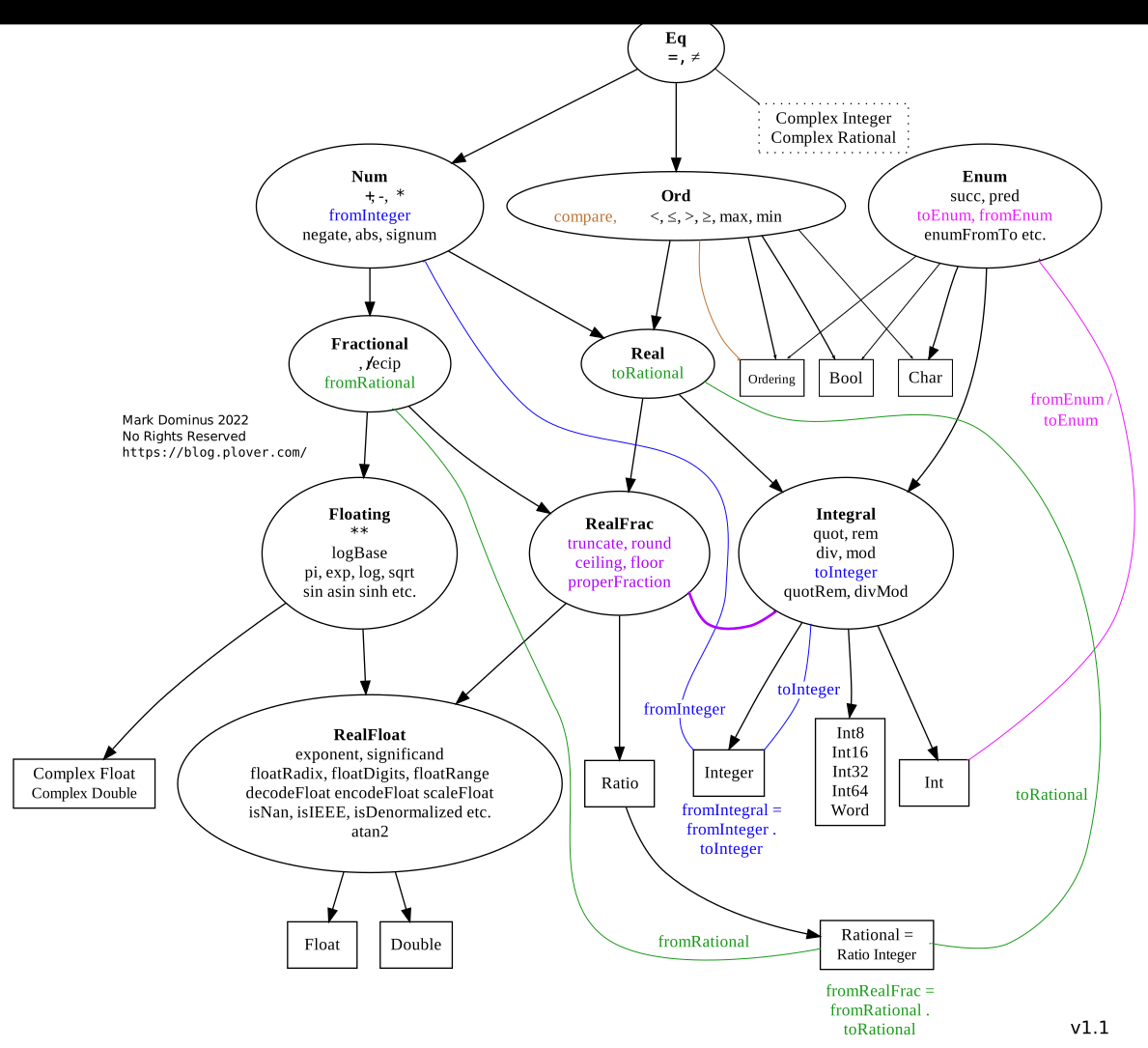
typeclasses/concepts/protocols/interfaces/traits: ad-hoc polymorphism;
i.e. the story of Haskell numbers. Instead of classify them by size
(uint8_t/uint16_t/uint32_t) or representation (integer/IEEE754/fixed
point), we classify them by behavior (what operations they support).
map/filter/reduce
interlude: array programming, and there's a language called APL/BQN/J/K (but Matlab & NumPy & Julia are the same idea in disguise)
the React idea: UI just a function of state
epilogue: What's a monad? (plant a seed, not fully explain, just list some examples) (List, Optional/Maybe, Result/Either)
(note to self: how to pack these loose ideas together?)
incomplete
welcome to the desert of the real
CPU frequency, and what a time base really is
first construct of non von Neumann architecture: interruption
Timer as the simplest peripheral (from 555 to SysTick) why it's necessary? CPU doesn't know time by itself
say when
push/pull model (and the duality of it)
epilogue: The Hollywood Principle: "Don't call us, we call you" Who is "we"?
It's a bad analogy since "us" in "don't call us" (the condition, the register) and "we" in "we call you" (the NVIC, the scheduler) are not the same figure, or it's not a symmetric relationship (there's no really calling) Also the subject is also ambiguous: the "you" is also different in both cases.
See Draft 4
why delay is bad (in Arduino sense)
blocking is dangerous/inefficient
naive round-robin loop (event loop)
what's being round-robined: state machine
coroutine as state machine
(stackless)
another way:
manipulation of stack (context switch)
(stackful)
pre-emptive or not? that's a question
epilogue: tease of sync primitive, and why do we need condition variable?
incomplete
function pointer -> closure -> (coroutine/generator/thread/callstack/exception) -> continuation
// better idea?