This is the reference implementation of the pika parsing algorithm, described in the paper:
Pika parsing is the inverse of packrat parsing: instead of parsing top-down, left to right, pika parsing parses bottom-up, right to left, using dynamic programming. This reversed parsing order allows the parser to directly handle left-recursive grammars, and allows the parser to optimally recover from syntax errors.
String grammarSpecFilename = "arithmetic.grammar";
String inputFilename = "arithmetic.input";
String topLevelRuleName = "Program";
String[] recoveryRuleNames = { topLevelRuleName, "Statement" };

String grammarSpec = Files.readString(Paths.get(grammarSpecFilename));

Grammar grammar = MetaGrammar.parse(grammarSpec);

String input = Files.readString(Paths.get(inputFilename));

MemoTable memoTable = grammar.parse(input);

ParserInfo.printParseResult(topLevelRuleName, memoTable, recoveryRuleNames, false);Program <- Statement+;
Statement <- var:[a-z]+ '=' E ';';
E[4] <- '(' E ')';
E[3] <- num:[0-9]+ / sym:[a-z]+;
E[2] <- arith:(op:'-' E);
E[1,L] <- arith:(E op:('*' / '/') E);
E[0,L] <- arith:(E op:('+' / '-') E);
The rules are of the form RuleName <- Clause;. AST node labels may be specified in the form RuleName <- ASTNodeLabel:Clause;. The rule name may be followed by optional square brackets containing the precedence of the rule (as an integer), optionally followed by an associativity modifier (,L or ,R).
Nonterminal clauses can be specified using the following notation:
X Y Zfor a sequence of matches (Xshould match, followed byY, followed byZ), i.e.SeqX / Y / Zfor ordered choice (Xshould match, or if it doesn't,Yshould match, or if it doesn't'Zshould match) , i.e.FirstX+to indicate thatXmust match one or more times, i.e.OneOrMoreX*to indicate thatXmust match zero or more times, i.e.ZeroOrMoreX?to indicate thatXmay optionally match, i.e.Optional&Xto look ahead and requireXto match without consuming characters, i.e.FollowedBy!Xto look ahead and require that there is no match (the logical negation of&X), i.e.NotFollowedBy
Terminal clauses can be specified using the following notation. Standard Java-style character escaping is supported, including for Unicode codepoints.
'['for individual characters"import"for strings of characters[0-9]for character ranges[+\-*/]for character sets (note-is escaped)[^\n]for negated character sets (note that this will slow down the parser, since a negated matching rule will spuriously match in many more places)
discriminant=b*b-4*a*c;
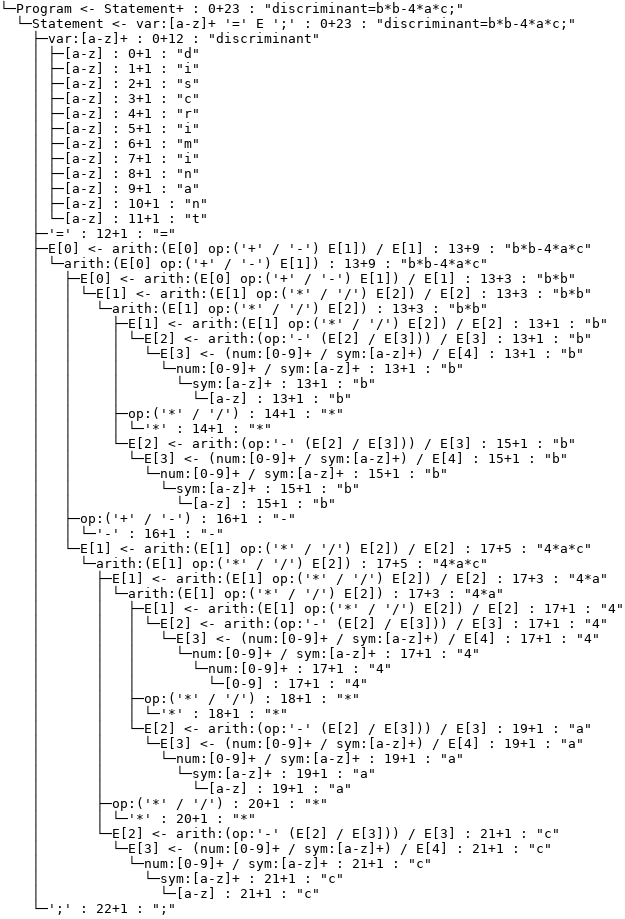
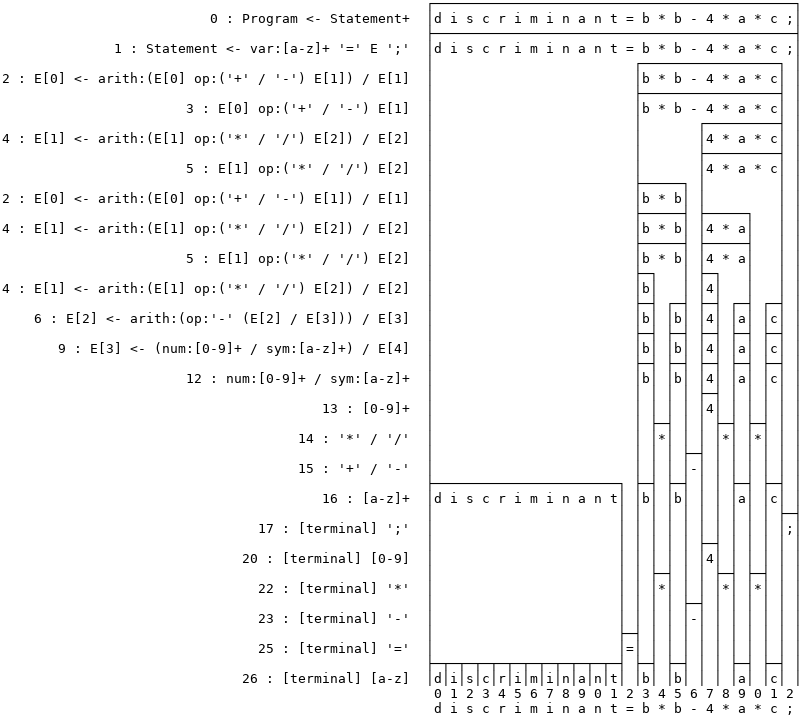
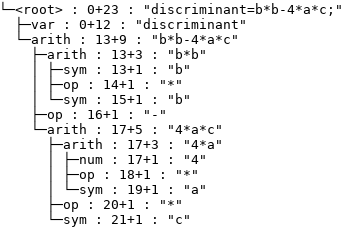
To find syntax errors, call:
NavigableMap<Integer, Entry<Integer, String>> syntaxErrors =
        memoTable.getSyntaxErrors(grammar, input, "Program", "Statement", "Expr");
or similar (list the names of all all the grammar rules that should span all of the input in the last varargs parameter). Any character range that is not spanned by a match of one of the named rules is returned in the result as a syntax error. You can print out the characters in those ranges as syntax errors. The entries in the returned NavigableMap have as the key the start position of a syntax error (a zero-indexed character position from the beginning of the string), and as the value an entry consisting of the end position of the syntax error and the span of the input between the start position and the end position.
You can recover from syntax errors by finding the next match of any grammar rule of interest after the syntax error (i.e. after the end of the last character matched by a previous grammar rule). For example:
NavigableMap<Integer, Match> programEntries = grammar.getNavigableMatches("Program", memoTable);
int matchEndPosition = 0;
if (!programEntries.isEmpty()) {
    Match programMatch = programEntries.firstEntry().getValue();
    if (programMatch != null) {
        int startPos = programMatch.memoKey.startPos;
        int len = programMatch.len;
        matchEndPosition = startPos + len;
    }
}
if (matchEndPosition < input.length()) {
    NavigableMap<Integer, Match> statementEntries = grammar.getNavigableMatches("Statement", memoTable);
    Entry<Integer, Match> nextStatementEntry = statementEntries.ceilingEntry(matchEndPosition);
    if (nextStatementEntry!= null) {
        Match nextStatementMatch = nextStatementEntry.getValue();
        // ...
    }
}

![@dependabot[bot]](https://avatars.githubusercontent.com/in/29110?s=64&v=4)